
Building Confidence Beyond the Classroom: Charlotte’s Journey into Specialist SEND Education
With a background in SEND experience and a passion for supporting pupils with additional needs, Charlotte wanted to build a career in teaching where she could make a difference. Through KMT’s Initial Teacher Training programme, she developed a strong foundation in adaptive teaching, scaffolding and inclusive practice. Now working as an Early Career Teacher in a specialist SEND school, Charlotte reflects on how her training prepared her for the next step in her teaching journey.
Even within the standard Mainstream nature of your Initial Teacher Training, how did the KMT curriculum integrate high-level SEND strategies (such as adaptive teaching, regulation, or trauma-informed practice) throughout the course?
KMT placed an emphasis on scaffolding and adaptive teaching, which I feel are important when supporting pupils with a range of individual needs. Although the training was mainly focused on mainstream education, these approaches provided a useful foundation that I have been able to apply in a specialist SEND setting. KMT also touched on SEMH and EAL learners, which broadened my understanding of the different barriers that can affect pupils’ learning and participation. Having already gained experience with SEND, I could relate some of the training to what I had seen in practice and build on that knowledge in my current role.
Were there specific training sessions, ITAP or expert-led workshops/subject knowledge enhancement days that felt uniquely tailored to SEND?
As a PE trainee, I attended ITAP sessions alongside the wider cohort of trainees, which gave me opportunities to explore teaching approaches beyond my own subject specialism. The sessions were not specifically tailored to specialist SEND education, but I valued the opportunity to learn alongside trainees with different experiences and perspectives. KMT also introduced us to areas such as SEMH and EAL, helping us consider the varied experiences and needs pupils may bring into the classroom. I found this useful because it encouraged me to think beyond my own subject and recognise the importance of making learning accessible to different pupils.
How did your KMT mentors or programme leads help you bridge the gap between classroom theory and the day-to-day realities of a specialist SEND environment?
My experience with KMT was amazing. The training gave me a solid grounding in the principles of effective teaching, while my previous experience with SEND helped me connect these ideas to the realities of working with pupils with additional needs. Moving into a specialist setting has allowed me to develop that understanding further through daily experience. I have continued to learn about the individual needs of my pupils and how to create an environment where they feel supported, included and able to make progress.
A key part of a special school role is working alongside additional adults in the classroom. How did KMT train you to lead a classroom team and collaborate with specialists?
KMT gave me opportunities to take part in team-teaching activities, which helped me gain practical experience of working successfully with another adult. These activities highlighted the importance of communication, cooperation and sharing responsibility to support pupils’ learning. Although the training was not specifically focused on leading a team in a specialist SEND setting, it gave me a useful starting point for collaborative working. In my current role, I have continued to build on this experience and develop my understanding of how teachers, teaching assistants and other professionals can work together to meet pupils’ individual needs.
In a SEND setting, understanding behaviour is vital. What specific framework or mindset did KMT instill in you regarding emotional regulation and behaviour support?
KMT introduced me to different pupil needs, including SEMH, which helped broaden my awareness of the factors that can affect engagement and learning. The course did not focus on one specific behaviour-support framework for specialist SEND settings, but it encouraged me to consider that pupils have different needs and may require different approaches. My experience in a specialist school has developed this understanding further, particularly the importance of being patient, recognising when a pupil may be struggling and considering what support might help them feel safe, regulated and ready to engage.
Looking back at your first few weeks as an ECT in a special school, what specific strategy, routine, or piece of advice from KMT did you draw on most?
The main strategy I drew on was breaking learning down into manageable steps and providing the right level of support for pupils to engage with a task, ensuring success. KMT’s focus on scaffolding helped me recognise the value of building learning gradually rather than expecting pupils to complete everything independently straight away. In a specialist school, I have found it important to consider each pupil’s starting point and provide support that helps them participate while still encouraging independence. This is something I continue to develop as I get to know my pupils and understand what works best for them.
How did KMT’s approach ensure you felt confident enough not just to teach in a mainstream setting, but to step directly into a specialist SEND school?
My confidence came from a combination of my previous experience with SEND and the foundation I gained through KMT. While the course was mainly mainstream-focused, it helped me develop an understanding of the responsibilities and core principles involved in being a teacher. My previous experience gave me some familiarity with SEND, and I knew that moving into a specialist school would also involve learning new approaches and developing my skills further. I felt able to take that step because I had a foundation to build on and was willing to keep learning from the pupils and colleagues around me.
In your opinion, what makes KMT’s curriculum stand out in preparing trainees to feel equipped for any educational setting?
For me, KMT’s strength was providing a foundation in the core principles of teaching that can be applied across different subjects and settings. As a PE trainee, I valued the opportunity to learn alongside the wider cohort and explore perspectives beyond my own specialism. Although the programme was mainly mainstream-focused, the knowledge and skills I gained have been useful in my current role.
If you could summarise how KMT prepared you for your special school career in one sentence or quote, what would it be?
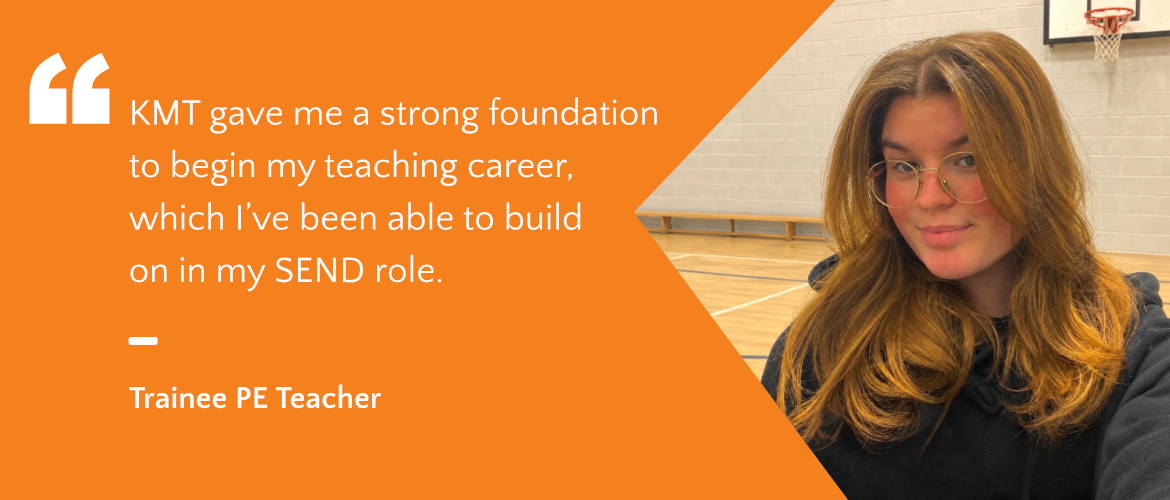
KMT gave me a strong foundation to begin my teaching career, which I’ve been able to build on in my SEND role, and my experience was so positive that I’ve encouraged others to begin their teacher training journey with KMT.